
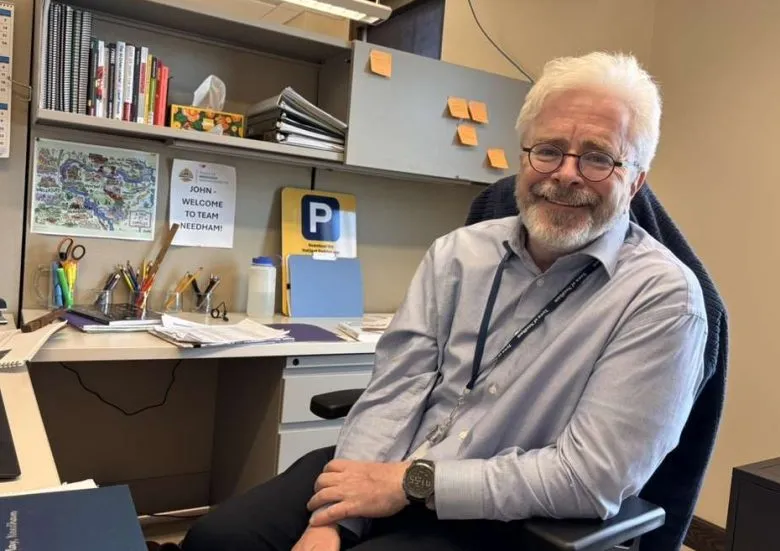
Needham’s new Economic Development Director, John Sisson, knows he needs to hit the ground running. The post he has occupied for all of two weeks now was empty for nine months, during which a major new employer (Boston Children’s Hospital) opened its doors and a coalition of small businesses in Needham Center asserted and reasserted that their preferences for possible Great Plain Avenue traffic and sidewalk changes were being overlooked by the Envision Needham planners.
In conversation Sisson was low-key, thoughtful, and wide-ranging, talking about streamlining the process for opening a business but also about a biography of Benjamin Franklin that showed him how many small business issues now were small business issues 250 years ago.
He comes across as someone more likely to calm things down than rile things up.
“I’m trying to get up to speed and understand the best role for me to play to help the town,” Sisson said. “And I think some of it has to do with serving as an ombudsman between the commercial sector and town hall. Projects like Envision Needham, what is my role there?”
Sisson brings both direct and indirect experience to the job. Economic development is his second career after more than 20 years in publishing, mostly books. When the 2008 economic downturn rocked the publishing industry, Sisson began thinking about changing direction.
“I got involved with a local group that was focused on sort of what we call village vitality and what residents can do to help address, say, commercial vacancies in the commercial area. It was really an education in zoning and regulation and how local governments can either help businesses or thwart commercial activity. ”
That led to stints at the state office of economic development and posts in Dedham and Newton.
“I grew up in a suburb of Chattanooga, Tennessee,” said Sisson. “And we did not really have the sort of town centers that you have in New England.” Moving to Newton, he and his wife chose a walkable part of town close to businesses and restaurants. “For me, coming here was a thrill.”
Sisson is starting with some basics: Reviewing the town’s permitting guide. Seeing if there’s an inexpensive — he’s looking at do-it-yourself software — way to track communication, permitting, and business data.
“It’s like Excel on steroids. What’s really great about it is, I can share it with different departments. If we can have this shared resource we can do better at being available.” He used the example of a water main break in one of the towns he worked in. The public works department knew how to contact the property owner, but it was the tenant’s business that was affected. “It’s the tenant who showed up at 8 in the morning to open up and found the sidewalk removed and a construction site in front of their business.”
Sisson says he wants business owners to know they matter.
“One of the best things you can do for business attraction is take really good care of your existing businesses,” Sisson said. “Because then when those businesses talk to others or when their property owners talk to others, or their real estate brokers talk to others, they say, ‘Oh yeah, Needham’s an easy place to get up and running.’ That’s what we want.”
One way to do that?
“I’m not a big fan of parking requirements,” Sisson said.
“Want more restaurants? What if you got rid of the parking requirements for restaurants? It’s not like the parking requirements actually create parking. All they do is put the onus on the small business owner — not the commercial property owner — to figure out where this invisible parking happens.”
He also hopes to work with other departments to consolidate permitting. Right now, he said, potential business owners have to fill out a number of applications in a number of offices to get started. What if there was a central application?
These streamlining and outreach efforts may be starting small, but Sisson said he believes in incremental change.
“I always counsel: let’s not jump to solutions. We need to work through the problem and understand it really well, and then maybe we provide some incremental changes to make sure that what we think is going to be the solution actually is the solution.”
Any new growth, Sisson said, is a positive. He pointed to an indoor plant, a “money tree” he’d been given as a welcome on his first day on the job. “It started dropping leaves the day after I got here,” he said. “But I started to give it some mist and it came back. Now there’s new growth.” Maybe it’s a sign.
 Save as PDF