
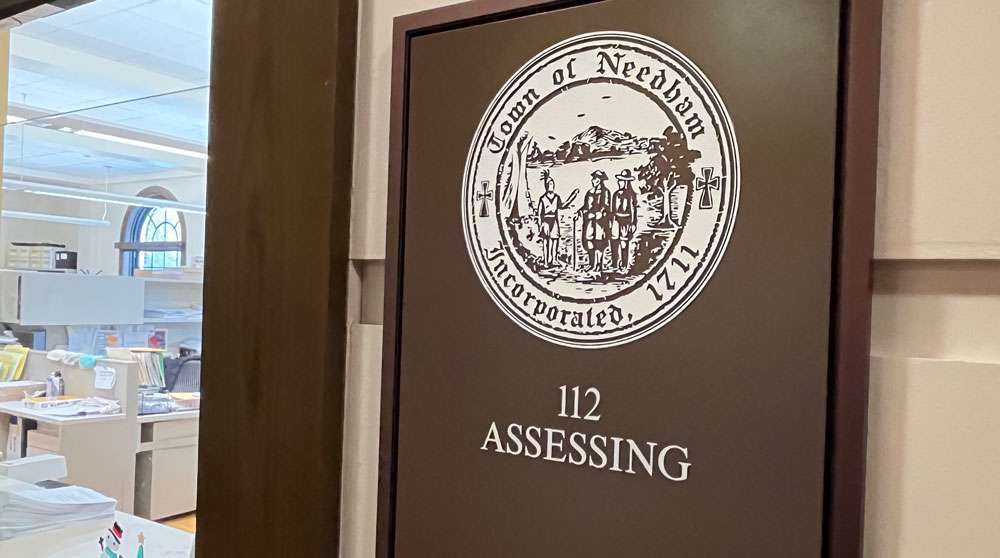
More than 350 property owners met the Feb. 3 deadline to file for property tax abatements in the wake of the town’s five-year revaluation process that skewed values and landed more heavily on bills for properties with smaller lots.
The town typically receives around 60 annual abatement applications but significant valuation increases led to sticker shock among hundreds of property owners, both residential and commercial.
This year’s abatement application number could still climb higher over the next two months. Some 20% of the town’s property owners who were sent corrected bills have been granted an extension until early April to submit abatement applications.
The three members of the town’s elected Board of Assessors will rule on the abatement requests on a case-by-case basis, a process that will begin at its Feb. 24 meeting. Abatement requests are confidential and the reviews are conducted in executive session. The board will review the applications in the order in which they were received, or very close to it.
The board discussed how it would handle the process at its Feb. 10 meeting and indicated that the high volume of applications suggests it may be a challenge to meet the requirement that applications be ruled on within 90 days of being submitted.
Some of that deadline pressure could be relieved if applicants fail to provide supporting documentation for their claims, which would allow the Board of Assessors to deny the application with minimal review. Applicants need not provide that documentation at the time of application. They have 30 days to do so, with the clock starting at the time of application.
“The application speaks for itself,” said board Chair John Bulian. “I say to people, you can file, but you need to get supplemental information. If you want to add supplemental information, you have to do it as soon as possible.”
Nancy Martin, the town’s assistant director of assessing, said the assessing staff assisted applicants who come to Town Hall. “If they handed it in at the window, everything was looked at — it was quickly, given the crowds,” she said of the steady traffic the office has seen over the past month.
Martin said the staff will likely send a follow-up communication to all applicants, reminding them of their deadline to supply supporting information.
The abatement process
The Assessing Department offers a guide to the abatement process on its website, including forms that need to be filed in support of the application. Taxpayers who received accurate bills needed to have filed by Feb. 3.
The town has no discretion to extend or waive that Feb. 3 deadline, so those who have yet to file most likely have no recourse for this tax year.
While a dramatic increase in a valuation is an obvious trigger, an increase is not, by itself, the basis for a successful application. In general, the taxpayer must identify some sort of error or inherent bias in the process. According to state guidelines, those can include:
Errors in property data — Perhaps the strongest argument an applicant can make is if the information on the town’s property card is incorrect — listing more square footage than the property actually has, or incorrectly listing rooms, bathrooms or features such as a garage or pool.
Overvaluation — The taxpayer can contest the assessors’ appraisal of the fair cash value of the property. This needs to be supported by providing comparable sales data, recent appraisals, or evidence of any defects in the property’s condition. Any or all can help substantiate that the assessor’s valuation is too high.
Disproportionate assessment — Similar to overvaluation, this occurs if the property is valued at a higher percentage of fair cash value than other properties due to an intentional, discriminatory assessment policy.
How did we get here?
The town has been without a director of assessing since the former director, Melissa Motta, went on leave over the summer. Motta’s employment ended in January and the town is conducting a search for a successor.
The bulk of the revaluation work was done by a contractor, Tyler Technologies, and was begun before Motta departed. It is common for municipalities to outsource this effort as it is time-consuming, resource-intensive and requires specialized data management systems — all things that the town’s four-person assessing staff lacks.
In Massachusetts, property assessments are required to be recertified every five years to ensure they reflect market values. Needham valuations were found to have been lagging the market so the recertification process led to a one-year 22% overall increase to bring values up to market levels.
That 22% increase did not mean the town could collect an additional 22% in property tax revenue.
Under the 1980s-era Proposition 2½ tax limitation law, only “new growth” can increase the tax levy beyond the 2.5% allowed. The vast majority of Needham’s 22% valuation increase was considered “market growth,” which cannot increase the annual levy. As a consequence, the total real estate tax assessment increased by a fairly typical 4.3%.
Still, the additional market growth led to hundreds of properties, mostly smaller lots, increasing in value by upwards of 30%-40% and being subject to significant property tax increases.
 Save as PDF