
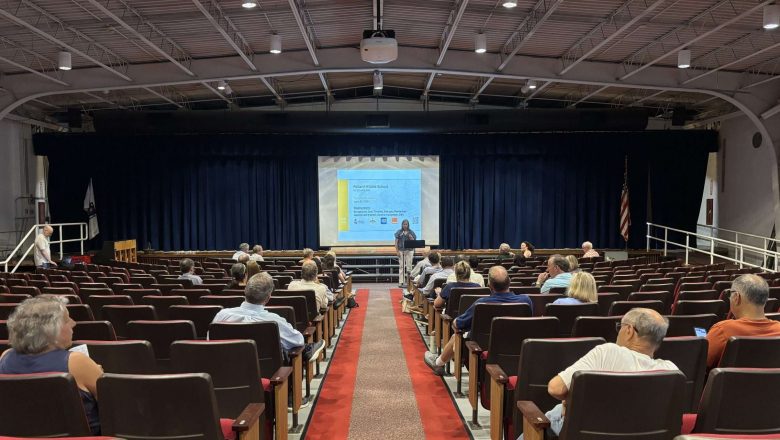
As plans for the new Pollard Middle School building enter final stages of design, some Needham residents continue to pose questions around the project’s scope and impact.
A public meeting Tuesday, June 30, brought questions around cost and the community’s role in project decisions moving forward. Residents also questioned the meeting date (scheduled days after schematic designs totaling $325.4 million were submitted for Massachusetts School Building Authority approval) for its proximity to the Fourth of July.
“This is kind of a tough time to get full participation,” said Melrose Avenue resident Kara Albert.
Alisa Skatrud, chair of the School Committee, who opened the meeting by touching on project goals, costs and MSBA reimbursement, noted this was the 35th public meeting on the project since January 2026.
Skatrud anticipates state reimbursement will land between $65 and $80 million, offsetting 20–25% of total project costs (parts of the project are ineligible for MSBA funding). She added that the MSBA will commit to a specific dollar amount toward the end of August. She also noted a tax calculator will be made available this summer on the town’s website for residents interested in specific real estate tax bill estimates for their properties.
Skatrud detailed some of the reimbursement calculation. The MSBA’s current reimbursement cap is set at $678 per square foot, and there’s a limit on total eligible square feet. Of that $678, MSBA pays a fraction based on the town’s wealth and need, estimated at 42 percent according to the presentation, or around $285 per square foot. Needham is responsible for the rest of the cost. The schematic design submitted June 25 estimates Pollard construction will cost $978 per square foot.
Brendan O’Malley from BOND Building Construction shared project timelines, Matt LaRue from HMFH Architects outlined interior and exterior schematics, and Hank Haff, the town’s Director of Building Design and Construction, shared cost projections related to the planned geothermal system.
Those residents looking for specific numbers as evidence of tight budgeting were dissatisfied with cost projections shared during the meeting. During Q&A, several questioned the cost of the planned 750-seat auditorium and geothermal wells.
Joe Abruzese of Bridle Trail Road, a Finance Committee member, asked if anything had been removed from the project’s design in the interest of reducing overall costs.
Superintendent Dan Gutekanst emphasized that project designs were built around existing programs and needs — not new initiatives — making it difficult to cut something from designs without compromising an existing program. Later in the meeting, Skatrud added, “There is no such thing as a smaller project unless you ditch the 6th grade or you cut educational programs.” Skatrud also noted the project master plan was made in tandem with the Finance Committee and Select Board.
In response to concerns about the longevity of a building created around existing needs, Gutekanst said, “I’m confident that we’ve done the right work for the spaces that we need — I will never guarantee that. Something may go amiss 20 years from now: COVID, for example.”
With the submission of schematic designs limiting the changes that can be made to project designs, several residents asked for clarity around the significance of community input moving forward.
“It would be helpful to understand at this point how much of these ‘input’ sessions are info sessions,” said Michael Layish.
Gutekanst said there remains room for small-scale adjustments, and that community feedback is still valuable — having already shaped decisions like the removal of solar shade structures from parking lot designs. Skatrud noted voters will get the final say Nov. 3, when they opt for or against the debt exclusion override that would temporarily increase property taxes to fund a new Pollard building.
When asked what Plan B would look like, Skatrud said, “I shudder to think what will happen if the override does not pass. Plan B is not pretty and, frankly, is more expensive.”
Gutekanst added that, should an override fail, Needham Public Schools would pull out of the MSBA process and focus on repairing Pollard (which, he estimated, could cost $167 million and not be eligible for MSBA reimbursement). School committee member Andrea Longo Carter said this would also cost Needham the use of High Rock Middle School as a future swing space when Mitchell Elementary School is rebuilt.
As in previous public meetings, abutters were among the most vocal June 30, voicing concerns related to the project’s proximity and impact on the surrounding neighborhood.
Abutters’ misgivings are echoed in questions posed by Needham Residents for Thoughtful Zoning (NRTZ), an advocacy group raising concerns surrounding the Pollard project. NRTZ has encouraged residents to participate in public meetings — highlighting questions around cost control, the future of High Rock and Mitchell, impact on taxpayers and alleged inconvenient scheduling of public meetings. NRTZ members are not identified on the organization’s website or email communications.
NRTZ is one of two advocacy groups that have actively taken a stance on the project.
Pollard Now, led by Meghan Small, Kate Linzmeyer, Dana Brown Malcolm, Stefanie Forman, Heather Salerno and Skatrud, supports current project plans and encourages residents to vote in favor of the project on Election Day. The organization’s website highlights the potential increase in local property values, an MSBA partnership and the need for a 21st-century facility.
More information on Pollard plans will be posted on the project website, and shared with residents at the next public meeting, scheduled for Wednesday, July 22.
 Save as PDF