
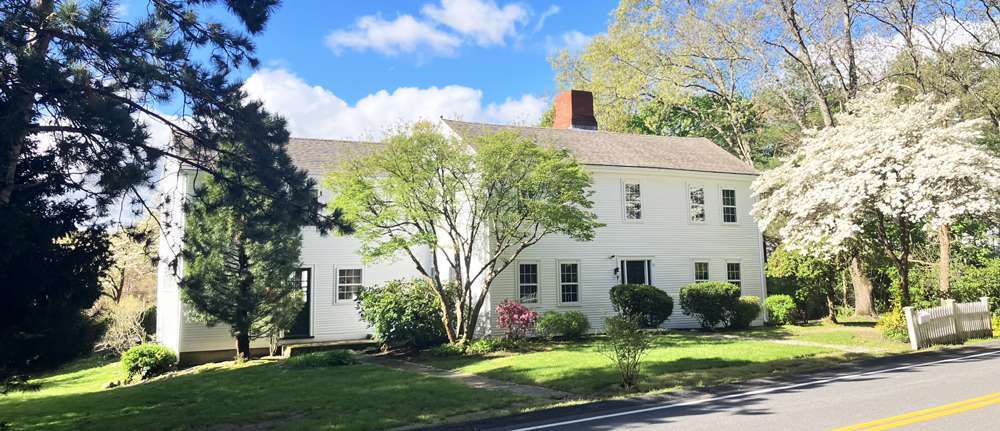
On Tuesday, the Select Board expressed interest in creating Needham’s second Local Historic District to preserve the historic home at 178 South St. In 2024, Needham adopted a bylaw that not only created the town’s first local historic district, but also allowed for the creation of others. The purpose of the designation is to preserve the look of buildings with historical and architectural significance.
“I would argue that this house is the most significant historic house in Needham,” Gloria Greis, director of the Needham History Center & Museum, told the Select Board.
The South Street home dates back to 1776 and once belonged to painter and illustrator N. C. Wyeth, who grew up in an adjacent family home while his grandparents lived in this one. The 1.25-acre property includes dramatic river frontage, and is currently owned by the N.C. Wyeth Research Foundation and Reading Libraries which has agreed to create this Local Historic District and has asked Greis to represent them.
In a local historic district, a commission reviews changes to buildings’ exterior features “visible from a public way.” Greis told the Observer that while a local historic district designation would save the 1776 historic front of the home, the mid-20th-century kitchen and family room on the river side would be fair game for removal.
“If you wanted to take those off, but preserve the old part of the house, that would be fine,” she said.
The N.C. Wyeth Research Foundation and Reading Libraries was originally funded by Linda Bean, the granddaughter of L.L. Bean. Prior to her death in 2024 the South Street building had been rehabbed and was close to opening to the public, replete with ADA-compliant features, including an elevator. With Bean’s death, the foundation lost its main source of funding and put the Needham property up for sale to help fund its other Wyeth property in Port Clyde, Maine.
Zillow currently lists the selling price at just north of $1.8 million and says that it is off market, but the broker, Michael Niden, says that he is still showing the property, something he has done hundreds of times since it went on the market in the fall of 2024. He said that it was always a strong possibility that it would be demolished.
“We had one person that was seriously looking at it,” Niden said. “They were going to tear it down and put up a 17,000-square-foot house.” Niden said that the 400 feet between the back of the house and the river could easily accommodate a massive structure.
Niden, who has deep connections to Needham, said he was always hoping that the historic home could be saved, and that creating a one-house historic district might be the best method to do that. Niden and Greis wanted to be able to finalize the district with a vote at Town Meeting in May, but state law has slowed them down.
Greis said that the town and the state did everything possible to make it happen, but “the law requires a meeting for public comment, and that can’t happen until 60 days after you’ve notified the Mass. Historical Commission and sent them a draft of the proposal.”
Niden said while the project awaits approval at Special Town Meeting in the fall, a buyer could still swoop in and buy the property with the hope of knocking down the historic home, but the town and the foundation’s interest in creating a local historic district lessens the likelihood of that outcome.
Needham’s first local historic district, created in 2024, also includes just one house, a common phenomenon across the state. The 1700s’ frontage of the Jonathan Kingsbury House at 3 Rosemary St. has been preserved, but modern amenities such as solar panels and an EV charger station are also present.
Greis said that Needham’s approach to preserving historic structures has flexibility that allows owners to update their homes. “If you went someplace like Concord and had a house in Monument Square, there would be a lot of very strict rules,” she said.
If it comes into existence, Needham’s second local historic district will preserve a structure that was not only once the home of the town’s most famous artist, N.C. Wyeth, but also the subject of some of his most important paintings. The house was in the Wyeth family for several generations. N.C.’s grandfather, Denys Zirngiebel, a horticulturist, developed the Giant Swiss Pansy there.
“The house has been a nexus for important events over its two and a half centuries.”
Another important artist, Robert Douglas Hunter, lived there, she said. “Longfellow visited there, and so did Tom Wolfe, author of The Bonfire of the Vanities.” Wolfe was a regular visitor when the house was owned by his cousin, Hilda Bottomley.
Greis said that the house is typical of its vintage. “A two over two, five-bay colonial” — that is, two bedrooms over two downstairs rooms with a center staircase and five front upstairs windows. She estimates that about 10 houses along South Street remain standing with a similar design. Most have been felled by the wrecker’s ball.
 Save as PDF