
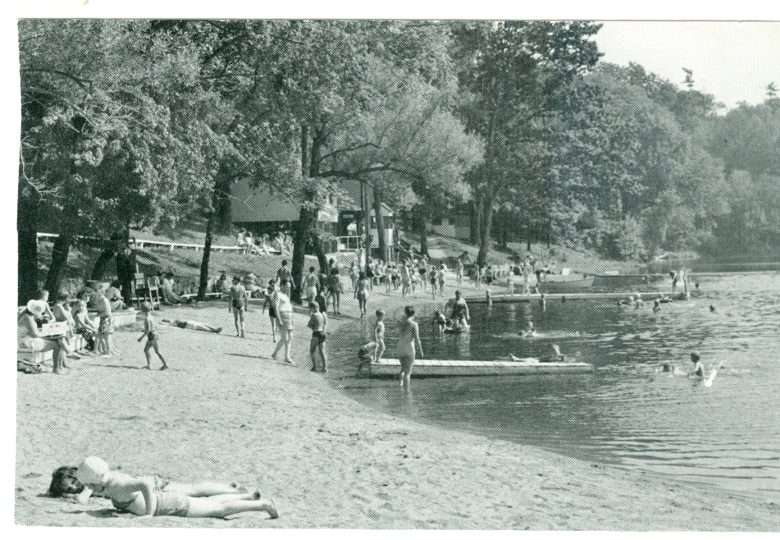
Rosemary Lake has been a central part of Needham life since the 1830s, but it had another life before that and many incarnations since.
When Needham was settled by native and then European Americans, the land that would become Rosemary Lake was an “alder swamp and a peat meadow,” according to George Clarke, author of the 746-page History of Needham Massachusetts 1711-1911. Then, Lemuel Lyon, a beaver hat manufacturer, dammed Rosemary Brook to create a source of water power for his factory.
Gloria Greis, director of the Needham History Center & Museum, said that the artificial lake was created in 1831 and hosted a variety of industries on its shores for the next 140 years. The name change took hold gradually, but Greis said early colonists to the Needham area described the widespread presence of wild rosemary, a different plant than European rosemary.
Digging out the shallow body of water, originally called Lyon’s Pond, with horses, carts and shovels took a year.
Clarke wrote that the newly harnessed water powered the creation of “huge beaver-hats, with bell-shaped crowns, large rims, and covered in long hair.”
The original mill was destroyed by fire and a long succession of other industries produced cotton batting, nails, hosiery, jackets and blankets. Greis added that hinges were also manufactured there and ice was harvested on the northern shore where the pool is today.
In 1884, the Keeler Manufacturing Co. made underwear there in a factory that employed a hundred people. When William Carter bought the Keeler factory in 1888, he first leased it to a company that made bicycles. In 1902, the William Carter Co. transferred “all of its machinery to this mill,” according to Clarke. It was known as Mill No. 2 or the Lower Mill and Needham became a global center of underwear production.
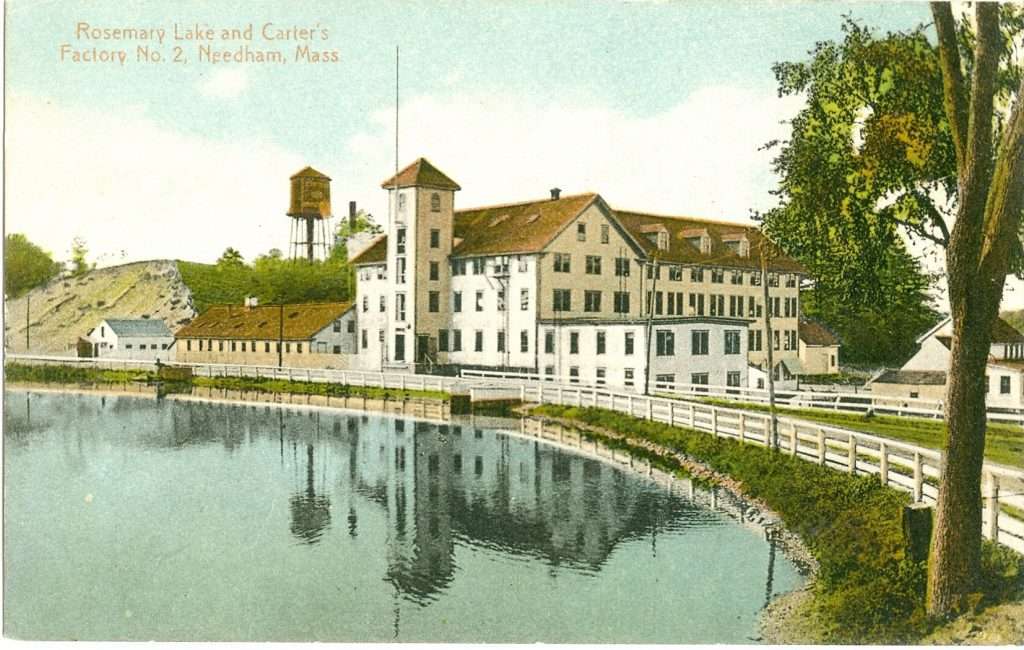
Greis said that Carter made union suits (one-piece underwear), undershirts and stockings there.
The last factory located on the shores of Rosemary Lake, and potentially the most environmentally impactful according to Greis, was Tillotson Rubber, which opened in 1931 and operated for more than 40 years. “A rubber factory generates a lot of sulfur,” Greis said.
A Sandy Beach arrives
In 1933, Needham shipped in sand to create a 300-foot beach and Rosemary Lake became the official town swimming hole. Prior to that Greis said that the town had a small spot for swimming on the Charles near the corner of South Street and Dedham Avenue. “It’s now a canoe launch which is why the path is still there,” Greis said. That river frontage was small and the currents were often strong.
Rosemary Lake offered more space, but as a swimming hole it was always limited by its shallowness and its muddy bottom. Gay Ellen Dennett, a reference and programming specialist at the Needham Free Public Library, remembers when swimmers used the lake itself — but that was before the late 1960s, when people became more aware of pollution. “It has always been the recipient of a lot of industrial runoff,” Dennett said.
“It’s not just pollution, but also just the silty substrate,” Greis said. “You were walking in muck, but also churning it up.”
The lake still drew crowds of bathers. The Needham Chronicle reported 22,000 visits during the first four weeks of the 1966 swim season.
“For those of us who weren’t at the Cape and weren’t in Needham Pool and Racket Club, we were there because there was no other place to go cool off,” said Trish Masi, a lifelong Needham resident who recently retired from a career as an operating room nurse at BID Needham, “I learned to swim quickly. I didn’t want to touch the bottom with my feet.”
Select Board Member Kevin Keane remembers being told by his older brothers that snapping turtles lurked in the opaque waters and he approached the lake with extreme caution.
Gary DeMaria, another lifelong resident, recalls failing a swim test because he refused to dive off the dock and swim to shore. “The waters were so dark, it seemed like jumping into an abyss,” he said.
In the late ’60s and early ’70s, the lake began to fail state water purity tests and closures became common. “In the ’70s, the state shut down swimming in the lake,” Dennett said.
In 1970, the lake was closed for the season and the YMCA expanded the hours of its indoor pool. The Pool and Racket Club allowed Red Cross Water safety classes to take place there.
The Needham Times and the Needham Chronicle reported that the Select Board, the Park and Recreation Commission and Town Meeting all struggled to find solutions. Greis said that in addition to industrial waste, lawn runoff that included fertilizer and pesticides were concentrated in the shallow waters.
The town’s search for a solution resulted in the construction of a temporary pool on the side of the lake. It was designed to last five or maybe 10 years at most and served the town for 45 years. As it aged, it suffered some of the same problems as the lake. It tended to close during heat waves, when it was needed most.
The first Rosemary Pool 1973-2016
Masi said, “When the new pool opened, we thought we were in heaven.” DeMaria was awed by its size, a surface area of 20,000 square feet, and he was glad that he was old enough to pass the deep water test and avoid the ankle deep section designed for very young children.
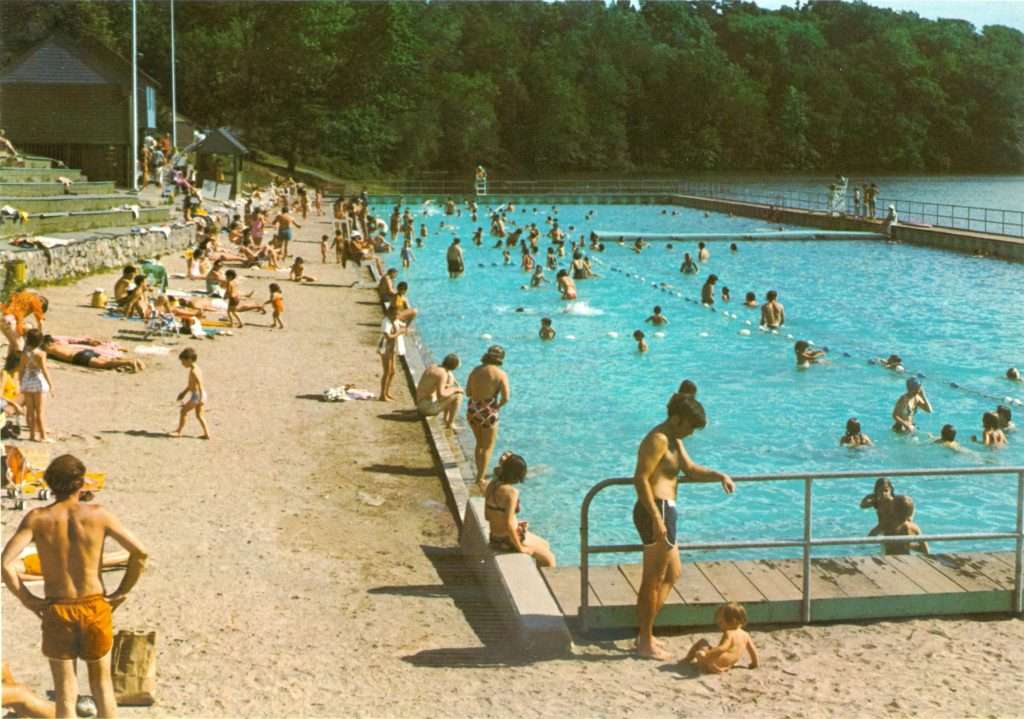
The Needham Chronicle reported that 50% of the construction costs were reimbursed by the federal government. In 1972, the opening year, a season pass cost $5. In 2016, its last year, the price was $90.
When she was raising her own family, Masi said that she enjoyed eating dinner with other Needham parents on the grassy slope above the pool on warm summer evenings while their children cooled off in the water below. “It was a place to connect with other Needham families,” she said.
The temporary pool design required draining the lake each spring when the water in the pool was changed or when the pool surfaces were repaired or repainted. Otherwise, the water pressure would have cracked the pool wall.
Cindy Chaston, who has served as a Park and Recreation Commissioner since 2004, said that when the pool was refilled it had to be in tandem with refilling the lake or pool walls would shatter outward. “It had to be equal,” Chaston said. “It was a little bit of a dance.”
Greis said that the drained lake was a magnet for waterfowl and a 2016 Park and Recreation brochure said that in spite of the yearly draining, “Wildlife has adapted and thrived during this time, and the lake has been shown to be healthier than other nearby ponds.”
Because of abutters’ concerns and state wetland regulations, 2016 was the last year the draining was allowed. During the 1970s, Town Meeting debated and approved funds for dredging the lake while it was drained in hope that the pollution could be mitigated and swimmers could return to the lake. In 1978 The Needham Chronicle reported that a return to lake swimming was unlikely.
In July of 1981, the Needham Times reported a pool closure, something that would become a regular feature of Needham summers over the next four decades. This was the beginning of a long struggle to determine how to maintain long-term access to swimming for Needham residents.
Keane said that the filtration system, designed to be temporary, started to break down, but that the old pool survived well beyond its expected lifespan. “The 1970s pool owed the town nothing. It served the town really well,” Keane said. “It was the worst of both worlds, a pond pool with sand. It had the problems of a pond and the problems of a pool.”
“Two days after the pool closed for the season, it started to turn key lime colored,” Keane said. “Then for the rest of the year, people would drive by seeing this really disgusting water.”
Chaston said that it took a lot of creativity and determination to keep the pool open for 45 years. “I anticipated every year that that pool would fail but it kept going,” she said.
The original Rosemary Pool closed its doors forever Aug. 26, 2016, but plans were already well underway for a new pool, one that could be maintained without draining the lake.
“From a community perspective, it was a family-friendly place and you couldn’t beat the price,” Chaston said. “But from the town’s perspective, it was a headache.”
 Save as PDF