
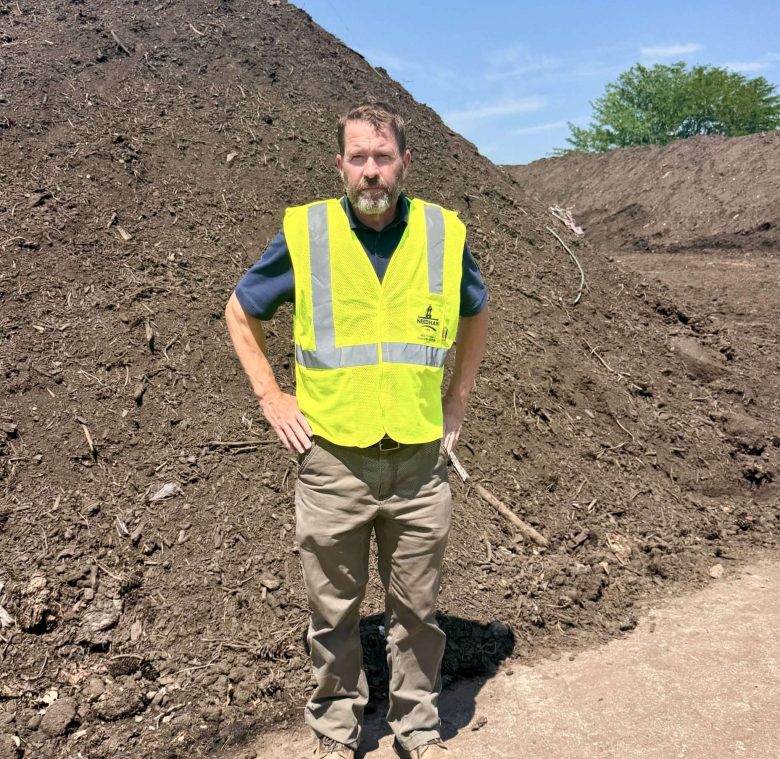
A guitar leans against the wall of Matthew DeMarrais’ nondescript metal office at the Needham Recycling and Transfer Station. On a desk behind him is a typewriter of the sort Ernest Hemingway used for his seven novels. They’re all castaways.
The guitar he will give to a music teacher; the typewriter, who knows? Once manager of the much-missed New England Mobile Book Fair, DeMarrais has an affection for writing instruments.
“Trash loads tell stories,” he said. “It might be parents who have passed away or moved to assisted living. Often their children travel up from a distant state with perhaps a week to spare, and as they run out of time, more ends up in the trash.
“Boxes fall to the floor and photographs from the ‘80s slide out, framed degrees, doctorates and certificates. The guitar came with a bunch of foreign currency.” DeMarrais’ sister is a professor of anthropology, so an interest in people and their lives is natural in this family.
DeMarrais grew up in Needham and cares about the community. Before he came to work at the RTS in December 2014, he worked for an environmental nonprofit called Earthworm. “It was started by MIT kids in 1970 when recycling office paper was not an option. Twenty years later they created recycling opportunities for computers and electronics equipment. All of our work was creative and physical.”
A growing family meant DeMarrais needed a job with better pay and benefits than an NGO could offer, so he accepted a post as assistant superintendent of recycling in Needham. He worked with the crew of 10 employees who process discards, create compost and mulch, and work with everyone from highway builders and roadmakers to landscapers and paper companies. In the past recycling was sold to China, but that market has shifted to buyers in India, Turkey and Vietnam.
As superintendent, he now focuses on budgeting and long-term planning. “We are guardians of public funds, and that creates an obligation. Needham trains us to be exceptionally diligent.”
Needham offers lots of options for recycling, but, he said, Greenpeace put out a study some years ago that showed overall plastic recycling was low. “It was meant to encourage folks to recycle more, but it dispirited consumers.” Yet options to recycle and reuse have increased. In Needham you can recycle everything from gently-used items at the Swap Shop, to that old refrigerator, sharps, paint, bottles, cans, cardboard, food waste and more.
Food waste is a major focus of waste reduction, DeMarrais said. The United States generates around 130 billion pounds of food waste a year — or about a pound of wasted food per person every day. We throw away almost half of every food item we buy. Forty-seven percent of waste comes from households, according to the Department of Agriculture. This in a world where 654 million people are food insecure. One in 10 Americans lack sufficient nutrition, according to the Federal Reserve. And one in five American children go to bed hungry each night, No Kid Hungry reports.
Less than 10% of those who recycle food waste at the RTS remember to remove contaminants like food packaging, plastic or paper. This means that the waste goes for processing in Leominster then to an anaerobic digester in Maine.
Needham collects food waste at schools and cafeterias with 10 gold stars for elementary school kids who tend to be assiduous about recycling, while high schoolers get a, well, you know… DeMarrais is loath to criticize anyone, pointing out highschoolers tend to be rushed and distracted.
Yard waste is a shining star, not just for the transfer station but for grateful residents who stock up on free compost, mulch and loam. Three to four times a year leaves, cut grass and brush are ground in a huge yellow machine behind the piles of steaming compost, which even in winter is a scorching 160 degrees Fahrenheit at its center.
Chris Willis, the foreman at the garden waste dump site, is “exceptional,” at keeping the area pristine and weeding out items that should not be among garden waste, DeMarrais said.
Although residents tend to be good about not putting trash in garden waste, the small staff at the transfer station still pull coffee and soda cans out of leaf drops. Walking among the compost piles, DeMarrais removes a metal pole and a piece of plank, which he carries with him. After Christmas, around 8,000 discarded trees are dumped. The worst nightmare, though, is the wire in wreaths that has to be painstakingly removed.
Residents are encouraged to leave organic garden refuse. The town doesn’t use pesticides or herbicides in any of its parks or gardens, and it seems residents are trending away from these harmful products among residents.
The RTS gets some “financial offset” too. The compost is sold to landscapers at $4 a yard. Cardboard waste earns $48 a ton.
From time to time, DeMarrais and his crew also have to deal with illegal dumpers, such as the individual who dumped 300 tires in the woods that had to be removed with front end loaders. Another time, 560 pounds of trash were dumped at Ridge Hill Reservation, the town’s public conservation land.
After posing for photographs, DeMarrais walks over to a bin to dump the plank and pole he has been carrying around. A Rotarian, whose club recently honored DeMarrais, pulls up and holds out his hand to congratulate this humble public servant. DeMarrais then walks back to his office to manage a dispute between a Swap Shop volunteer and a resident; he needs to make the peace.
Charlene Smith is an award-winning journalist and author, a Massachusetts Master Gardener and co-chair of the Needham Garden Club Horticultural Committee
 Save as PDF