
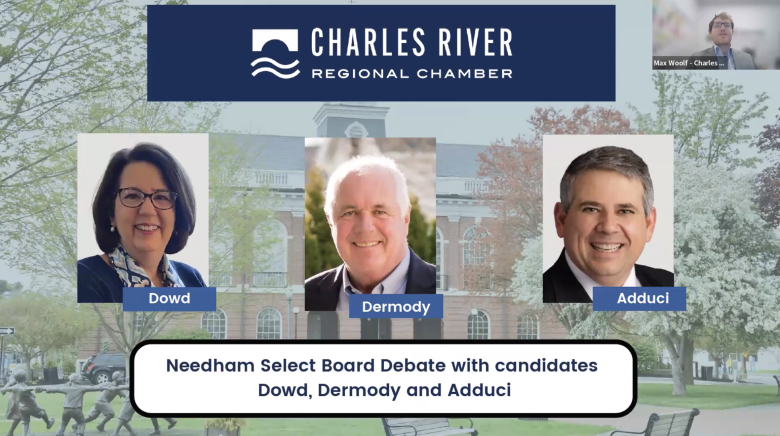
At a March 17 online forum dedicated mostly to business issues, the three candidates for Needham Select Board, including the one incumbent, agreed on one point in particular: that the board has been prone to getting ahead of the public on certain policy issues and would benefit from a more open-ended approach to major initiatives going forward.
In the one-hour session sponsored by the Charles River Regional Chamber, the candidates talked at length about lessons to be learned from the turbulence around Envision Needham and the MBTA Communities Act and what the board might have done differently.
“Having lived through the past couple of years, sometimes it’s better to move more incrementally and get wider support than to move more boldly and get narrower support,” said Select Board Vice Chair Cathy Dowd, who is seeking a second three-year term on the board.
At least one of Dowd’s two challengers will join the board after the April 14 town elections, as Marianne Cooley is not seeking a new term. The challengers are long-term resident Bill Dermody and relative newcomer Rich Adduci, both of whom advocated for a Select Board that does more listening before acting.
“Let’s get input. Let’s hear from people,” said Dermody.
A real estate professional for more than 30 years, Dermody is regional sales manager for Berkshire Hathaway HomeServices Commonwealth Real Estate on Great Plain Avenue. He is also a third-generation Needhamite with a lengthy record of service to the town in both public and private capacities.
He has been a Town Meeting member since the 1980s, served on the Park & Recreation Commission for two terms in the 2000s, is currently on the Memorial Park Trustees and has served on countless town volunteer efforts.
“I’ve been involved with so many aspects of Needham that I really feel like this is the best position for me,” he said.
Adduci moved to Needham in late 2023. His nearly 40-year work career has been in technology consulting, the past eight providing technology and cybersecurity advisory services to private equity funds as head of his own business.
“I believe a lot of my experience can really come to bear here in Needham in working to build a much more collaborative Select Board to improve the way we listen to our constituents and make sure that we place the views and needs of our constituents ahead of our own,” he said at the outset of the Chamber event.
“I moved to Needham in 2023 and immediately attempted to get involved in the town government, but was unsuccessful getting chosen,” he said of his efforts to serve via the town’s more than 40 volunteer committees.
He made a subsequent attempt and was appointed to both the Technology Advisory Board and the Community Revitalization Trust Fund — appointments made by Dowd in her role as vice chair.
Dowd noted she also recommended adding more business owners to the Envision Needham Center Working Group when that process began to show signs of fraying, with business owners vehemently opposing reducing the number of travel lanes on Great Plain Avenue and other elements of the proposed redesign of the town center.
“When the plan was first proposed, I sat with business owners, and they shared with me their very deep concerns about it. Ultimately, they told me that they felt that the town didn’t care about them and honestly, that really made me sad. That is not how I want the town to be.”
“I want to acknowledge that our process in rolling this out was flawed and those flaws really broke trust with business owners and with the community,” she said.
Both Dermody and Adduci questioned how the two-lane traffic option for Great Plain Avenue ever gained traction in the first place.
“I’m sitting in my office right now, which is on Great Plain,” said Dermody. “I look out there every day and I can see what the traffic looks like. I just can’t imagine going down to a two-lane Great Plain.”
“I don’t know how you could ever think two lanes is going to work through downtown on Great Plain,” Adduci said.
“I’m disappointed that this program really damaged the trust that our businesses have.”
When the subject turned to housing, all three candidates again agreed that a “go slow” approach was preferred. That involves tracking the impact of the new MBTA Communities Act zoning before making additional policy changes.
“Now that we are in compliance with the MBTA Communities Act, I think what we need to do now is work very closely with the Planning Board in looking at the parcels that are within the Communities Act and finding housing,” said Dermody.
“And I think the housing we need to do is smaller units, smaller projects, like maybe 700-square-foot, 800-square-feet units,” he added, referencing workforce housing projects already underway on both Chestnut Street and Hillside Avenue.
Adduci concurred, endorsing going slow and also going small.
“I’m with Bill. I think in the short term, I would start looking at what could we do to incentivize building smaller houses,” he said.
“Unfortunately, it becomes much better economically for builders to build larger houses,” he added. “That makes sense. We don’t want to cheat seniors on a property value, but we need to find ways to also create spaces that make sense to build small houses on and that developers want to do.”
Asked by debate moderator Max Woolf, the Chamber’s Public Policy & Government Affairs Manager, when would be the right time to revisit the MBTA plan, Dowd was direct.
“I’m not sure ever,” she said. “I think doing it in such a large fashion maybe isn’t the right way to go. I think that looking project by project and seeing what we can do that makes sense is perhaps a better way.”
 Save as PDF