
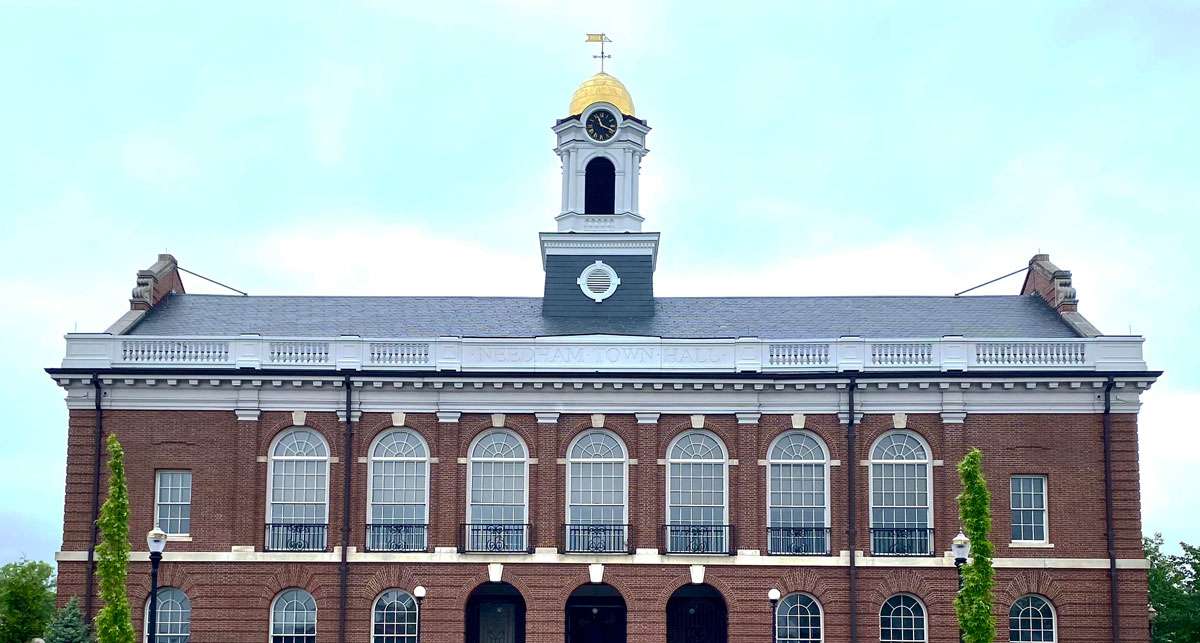
With residential property values continuing to grow and commercial values actually declining, the average single-family tax bill in Needham will increase by 7.52% in 2026, the largest annual percentage increase since 2020.
For the average single-family home valued at $1,541,061, that bump will increase the annual tax bill from $15,523 to $16,690. It will add $291.77 per quarter or $1,167 per year, beginning with the bill that will be due Feb. 1, 2026.
The town’s 9,672 residential properties, including 8,423 single-family homes, are cumulatively valued at $14.745 billion. They account for 88.11% of the town’s total assessed values of $16.735 billion.
Under its longstanding tax classification policy, Needham maintains a split tax rate where commercial, industrial and personal property is taxed at a rate that is almost twice that of residential property. The Select Board voted unanimously at the Nov. 25 tax classification hearing to set the FY2026 commercial tax rate at $20.09 per $1,000 of valuation and the residential rate at $10.83 per $1,000 of valuation — the highest tax rate “shift” between the two types of properties that state law allows.
Like Property Values, Tax Bill Changes Fluctuate

“The shift adopted by the Select Board effectively reduced the residential tax bill by 10%,” Town Finance Director Dave Davison told the Observer. “For the average single family home, the shift results in a $1,880 savings in taxes for the year.”
Even with the tax break residential taxpayers gain from the shift, they will still be responsible for 79.2% of the town’s property taxes. This is slightly up from last year’s 77%, and the highest residential share since 2007.
Commercial, industrial and personal property taxpayers, who account for 12% of total assessed values, will pay the remaining 21%.
The 7.5% average bill increase does not mean town spending will be increasing by that same percentage. Including the commercial properties, the total property tax revenue is expected to grow 4.8%, from $192.4 million to $201.7 million. The FY2027 budget is in development and overall town spending is expected to increase around 5% for FY2027.
Impact of new growth
Massachusetts Proposition 2½ limits how much a city or town can raise from property taxes. Annual tax growth is capped at 2.5% plus “new growth,” which can vary greatly from year to year and among the various property classes.
New growth tax revenue is derived from improvements to property through a new use, reconstruction or new construction, and is added to the tax base. It is a key metric in determining how much new tax revenue a municipality can generate.
For example, when an existing home is torn down and replaced by a new structure, the difference between the new and old valuation is added to the town’s tax base.
When a home valued at $1 million is torn down and replaced by a home valued at $2 million, that adds $1 million to the town’s tax base. At the new tax rate of $10.83 per thousand, that teardown would add $10,830 to Needham’s tax levy.
By contrast, if a home with a tax valuation of $1 million were to be sold for $2 million but not torn down, that $1 million is considered “value growth,” not new growth. It adds nothing to the overall tax base. It will, however, increase the tax bill of that particular property and pass the difference to other taxpayers.
Needham has seen significant new growth among residential properties and a near total lack of such taxable growth in the commercial and industrial sectors over the past two years. This, along with the trends in residential vs. commercial property value, has increased the proportional property tax burden of residential taxpayers.
In the current year, Needham registered $293.7 million in residential new growth, compared to just $64,600 in commercial new growth. This means residential new growth added more than $3 million to the levy while commercial new growth added around $1,300.
Personal property new growth was $49 million. This was a nearly $20 million drop from the prior year but will still add nearly $1 million to the tax base.
Bills will be higher, but less volatile
This year’s classification follows a rocky year for the town’s Assessing department in which it completed a state-required five-year recertification process that led to a dramatic shift in townwide property assessments.
The recertification effort revealed that the town had failed to keep up with the appreciation in the fair-market value of its residential properties over the course of the years between recertifications. The required correction led to a 22.8% increase in overall single-family home values that needed to be absorbed in a single tax year.
This resulted in hundreds of properties, mostly smaller lots, increasing in value by upwards of 30% to 40% and being subject to significant property tax increases. It also led to the Board of Assessors having to adjudicate abatement requests from 255 residential and 135 commercial property owners.
Nearly half of the requests have resulted in downward revisions of the assessments with 50 cases — 47 of them commercial taxpayers — having been appealed to the state’s Appellate Tax Board.
It also led to a crush of taxpayers showing up at the Assessing department’s Town Hall office looking for explanations.
“There were some people that were very upset and some people that were crying,” John Bulian, chair of the Board of Assessor said at the classification hearing. “It was a challenging time for the department.”
That process was well underway when Julie Castor-Deas took over as director of assessing in April.
“I’ve been here officially six months. So, 400 abatements and dealing with attorneys and whatnot,” she told the Select Board at the hearing when asked if steps are being taken to head off a repeat of the chaos when the next five-year recertification occurs.
“Understanding was the main thing, as I think I said when I first got here. That’s what I wanted to give to the community,” she said.
“I do feel as though that we’re not going to see the same amount of abatements. With the plan that I have in place you won’t see the sticker shock in five years.
“I’m definitely going to be on it, and I have an awesome team that just needed a little bit of guidance on how we’re going to do that.”
 Save as PDF